When we make decisions about the technology to obtain in an organization, we must recognize there exists a total cost of ownership (TCO) which reflects the sum of all the costs associated with using any piece of technology or technology system (Consortium for School Networking, 2003). These costs can include infrastructure and utilities, costs related to security and maintenance, and operational costs.
Consider the costs associated with installing a 25-station multimedia computer room in a school. In this case, I will assume there is a classroom that is configured as one would expect for the standard model of education: desks in rows with a teaching station that has a projector and screen in the front of the room. We plan to install 26 identical workstations, 25 for students and one for teaching. Because of the nature of the software that will be used, the computers must have a full operating system. The following will contribute to the TCO:
- Furniture—It is likely the student desks in most classrooms would not be appropriate for placing computers for student use, so new tables are likely to be necessary.
- Network infrastructure—Connecting desktop computers to the local area network and the internet is typically done via wired Ethernet cables. Installing and configuring the switches necessary to manage these devices will affect the TCO.
- Electrical infrastructure—Most classrooms do not have sufficient electrical outlets for 26 computers, and if the outlets do exist, they are unlikely to be located in the center of the classroom where most of the computers in this room would be located, so the TCO would require professionals with the proper credentials to install the necessary outlets.
- Software—Depending on the exact needs of the curriculum, the operating system and applications needs for the courses to be taught in this multimedia room must be obtained.
- Peripherals—Also affecting the TCO of this multimedia room would be the cost of printers, cameras, and similar devices to aid in the production and distribution of projects students create there.
- IT support—Installing and managing the hardware and software to ensure it is secure and reliable in this room would cost time from the IT staff. While adding a single room with 26 full operating systems and multimedia applications would probably not necessitate a full-time person to manage, it would consume some of their time.
- Training—Depending on the nature of the software and the skills and knowledge of the people to be using it, resources may be necessary to ensure it is used properly, so the students benefit from the full capacity of the computers and software.
Figure 8
TCO of School Technology
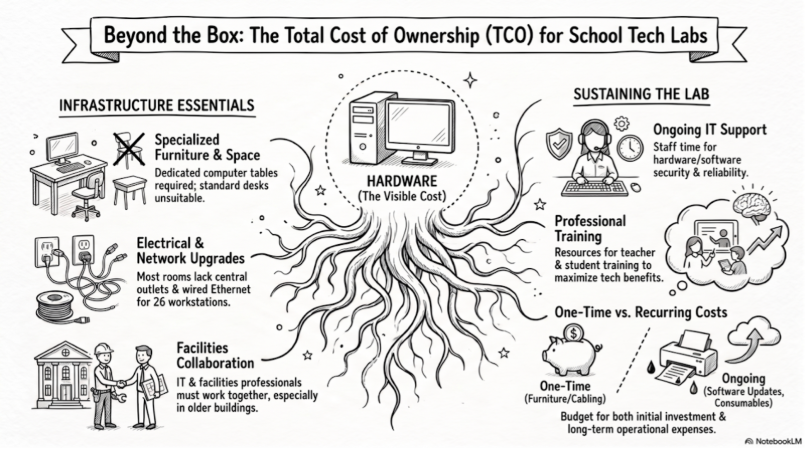
The list of items that comprise the TCO for any IT projects is going to include some one-time expenses, for example furniture and networking infrastructure that are likely to extend for much of the life of the IT, and on-going expenses. Deploying software updates and performing other maintenance and consumables such as ink or toner for printers are examples of on-going TCO expenses. Yet other TCO expenses can vary. For example, once teachers become knowledgeable about the software and understand how best to use it, the training costs may disappear but return if new teachers begin using the space.
IT professionals who collaborate to create efficacious educational technology understand the costs associated with TCO and work with those other professionals to ensure they can manage IT projects with their own projects. In my experience, one of the most important relationships any IT professional can have when working in a school is with the facilities professionals. This is especially true when you manage IT in old buildings that were constructed decades before IT was being installed.